Demand Response
A strong, robust grid is a win for everybody.
A strong, robust grid is a win for everybody.
In the United States, the average home uses 10,812 kilowatt-hours (kWh) each year. The global average is just 3,500 kWh. All this usage can cause issues for U.S. energy providers, especially during demand spikes, and may require the help of their customers to manage the demand — this is called Demand Response.
During periods of high energy demand, like on extremely hot (or cold) days, your energy provider may ask you to briefly reduce your energy use to help keep the electric grid stable. Since cooling/heating your home accounts for roughly 48% of your energy use, demand response typically involves your thermostat.
Signing up for a demand response program, like Connected Savings, is one of the easiest things you can do to automatically reduce usage during high-demand periods using a Wi-Fi thermostat. When you sign-up for a demand response program, you save money and power, while helping the environment!
Demand Response programs can save you money.
Some energy providers can charge up to 7X the typical rate during peak demand.
More than 10% of peak U.S. energy could be cut with Demand Response. This eases the stress on electric utility systems and keeps energy costs low.
U.S. homes release 150 million tons of CO2 into the atmosphere through heating and cooling. Using less energy reduces pollutants for a healthier environment.
Connected Savings analyzes your thermostat usage and compares it to our proprietary weather data. This helps us understand how your home will react to weather conditions that impact energy consumption so we can determine how best to manage your usage during peak demand.
An energy model, simply put, is a simulation of how your home uses and transfers energy. Our team of data scientists creates one for every home we manage and uses it to determine the best way to manage your energy while limiting the impact to your comfort.
When your utility expects a spike in demand, they will let us know. We then precool (or preheat) your home before the Demand Response event so your home is comfortable. During the event, we’ll make brief and limited changes to your thermostat to reduce your energy use. You can opt-out of an event by simply changing the temperature on your thermostat at any time.
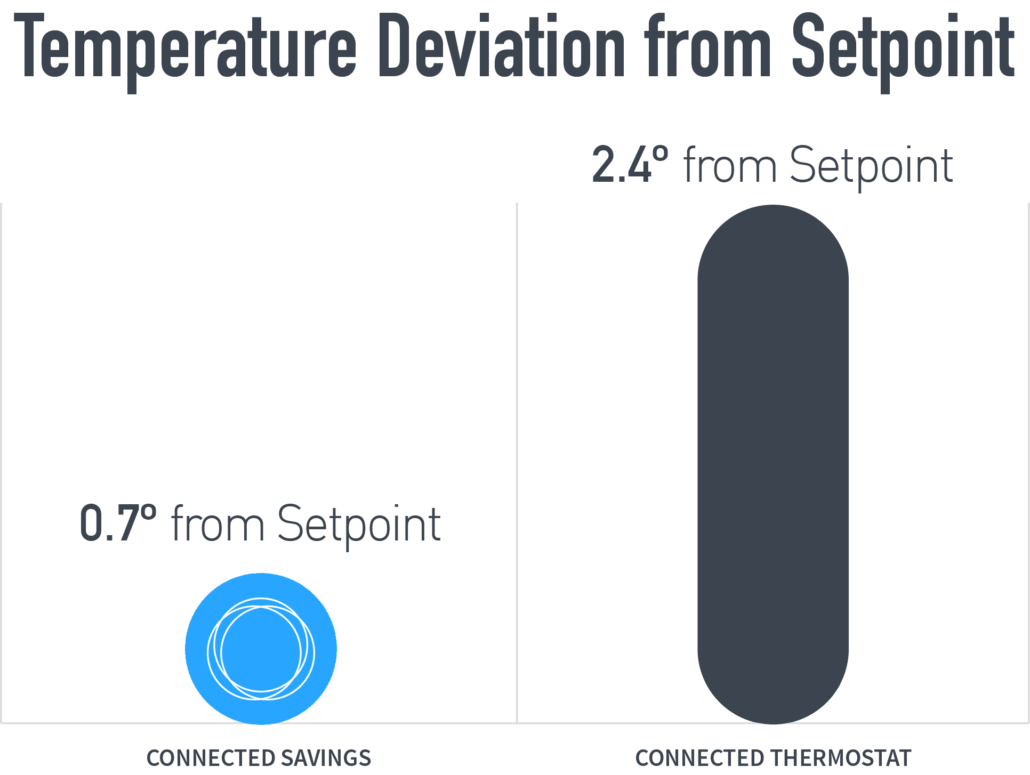
Once the Demand Response event concludes, your thermostat will go back to its normal behavior. By the end of the event, homes with Connected Savings are typically within 1°F from the temperature setpoint so the impact to comfort is minimal!
Schedules tell your thermostat what temperature to keep your house based on the times you leave and return home each day. Higher temperature setpoints in the summer (and lower in the winter) when you’re away from home save more energy.
Here’s a suggested schedule to get you started:
In the summer, for the hours you’re home, program your air conditioning to 75°F. When you’re away from home, set the temperature to 80°F.
In the winter, for the hours you’re home, program your heating to 69°F. When you’re away from home, set the temperature to 63°F.